

Country Club Membership Costs in Palm Springs & the Coachella Valley: The Complete Buyer’s Guide
By Sheri Dettman, Sheri Dettman & Associates | YourResortHome.com
Wondering what it really costs to live in one of the Coachella Valley’s country club communities? Beyond the price of the home, you’ll want to understand membership options, initiation fees, monthly dues, HOA costs, and ongoing ownership expenses. This guide explains how the costs are structured, what questions to ask before you buy, and how to compare communities with confidence.
If you’re considering buying a home in one of the Coachella Valley’s private golf communities, you’re probably asking one important question:
How much does country club living really cost?
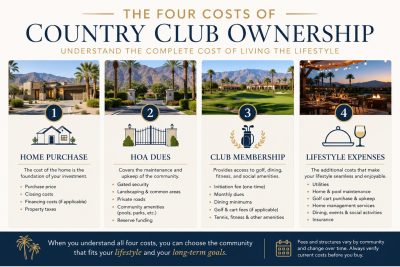
The answer goes far beyond the price of the home. Membership requirements, initiation fees, monthly dues, HOA assessments, and optional lifestyle amenities all play a role. While every club is different, and fees change regularly, understanding how these costs are structured will help you compare communities with confidence and avoid expensive surprises.
After more than 20 years helping buyers purchase homes throughout Palm Springs, Indian Wells, Rancho Mirage, Palm Desert, La Quinta, and the surrounding communities, I’ve found that the buyers who are happiest with their purchase are the ones who understand the complete financial picture before they write an offer.
This guide is designed to help you do exactly that. Rather than listing membership fees that may be outdated a few months from now, I’ll explain how country club costs work, what those costs typically include, and the questions I encourage every buyer to ask before purchasing. As I publish in-depth guides for individual clubs, you’ll also find links throughout this page to help you compare specific communities.
What Does It Really Cost to Live in a Palm Springs Country Club Community?
The purchase price of the home is only one part of the equation. Depending on the community, you may also encounter:
- HOA dues
- Country club membership dues
- Golf membership initiation fees
- Monthly dining minimums
- Capital improvement assessments
- Tennis or fitness memberships
- Cart fees
- Guest fees
- Special assessments
The important thing to understand is that not every homeowner pays every one of these expenses.
That’s one of the biggest misconceptions I hear from buyers relocating to the desert. Some communities require every homeowner to belong to the club. Others make membership entirely optional. Some clubs offer several membership levels with dramatically different costs. Others separate golf from social memberships, while a few have no membership requirement at all.
Knowing how each community is structured can save you tens of thousands of dollars and help you find a neighborhood that fits both your lifestyle and your long-term budget.
Are All Country Club Memberships Mandatory?
No, and this is where many buyers get confused. There are generally three types of country club communities throughout the Coachella Valley.
Mandatory Membership Communities
In these communities, purchasing a home also means joining the club. Membership is tied to ownership, and buyers should expect to budget for both HOA dues and club dues from day one. These communities often appeal to buyers who want an active social atmosphere because virtually everyone participates in club life.
Advantages include:
- Consistent amenities
- Strong social calendars
- Well-funded facilities
- Stable membership participation
The trade-off is simple: you don’t have the option to decline membership.
Optional Membership Communities
Many of the desert’s most recognizable golf communities operate this way. You can own a home without belonging to the club. If you later decide you want golf privileges, dining, tennis, fitness access, or social events, you can apply for membership.
This flexibility appeals to:
- Seasonal residents
- Buyers who travel frequently
- Golfers who play several clubs
- Owners purchasing primarily for investment
- Residents who simply prefer not to join
One misconception is that optional communities are somehow “less active.” That’s rarely true. Many have thriving club cultures with hundreds of participating members while still allowing homeowners to choose whether membership fits their lifestyle.
Communities with Multiple Membership Options
Increasingly, clubs recognize that not every homeowner wants the same experience. Instead of one required membership, they may offer several options, such as:
- Full Golf Membership
- Sports Membership
- Racquet Membership
- Social Membership
- Fitness Membership
- Seasonal Membership
These tiered structures allow buyers to pay for the amenities they’ll actually use. Someone who plays golf three times a week may choose full golf privileges, while another homeowner may value fitness classes, dining, and social events without ever stepping onto the first tee. Understanding these options is often more important than comparing initiation fees alone.
What Does an Initiation Fee Actually Pay For?
A country club initiation fee is a one-time cost to join the private club itself. It isn’t a prepaid membership, it isn’t a down payment, and it usually isn’t refundable.
Those funds often help support:
- Club improvements
- Facility renovations
- Long-term capital projects
- Member amenities
- Operational reserves
Every club structures these fees differently. Some charge a substantial one-time initiation fee. Others periodically waive it during promotional periods. Some adjust pricing based on demand. A few communities have eliminated initiation fees altogether while increasing monthly dues instead. Because clubs revise these programs regularly, it’s always worth verifying the current membership structure before making a purchase decision.
How Much Are Country Club Initiation Fees?
Across the Coachella Valley, initiation fees range from no initiation fee at all to well into six figures for the most exclusive clubs. This is one of the most searched questions about desert golf communities, and the honest answer is that there isn’t a single number.
The amount depends on several factors, including:
- Club prestige
- Number of golf courses
- Membership demand
- Waiting lists
- Recent renovations
- Ownership structure
- Whether memberships are capped
Rather than focusing only on the initiation fee, I encourage buyers to look at the entire ownership picture. Sometimes a club with a higher initiation fee has lower monthly dues and stronger long-term value. Other clubs advertise no initiation fee but have significantly higher ongoing carrying costs. Looking at only one number rarely tells the whole story.
What Do Monthly Country Club Dues Cover?
Monthly dues are what keep the club operating every day. Exactly what’s included varies by community, but dues commonly support:
- Golf course maintenance
- Clubhouse operations
- Restaurants
- Fitness centers
- Tennis and pickleball facilities
- Pools
- Social programming
- Member events
- Landscaping
- Staff
- Security
- General maintenance
Some memberships include unlimited golf. Others charge separate cart fees. Some clubs include fitness. Others offer it as an upgrade. Dining minimums also vary considerably. Rather than thinking of these as an additional fee, many members view them as a commitment to use the club’s restaurants throughout the year.
When comparing clubs, it’s important to understand not only how much the dues are but what those dues actually include. That often changes the value equation considerably.
How Do HOA Dues Fit Into the Overall Cost?
One of the biggest surprises for buyers relocating to the desert is learning that HOA dues and country club dues are usually two separate expenses.
Even in communities with mandatory memberships, your homeowner’s association and the club typically operate independently. That means you’ll want to understand exactly what each covers before you make an offer.
HOA dues often include things like:
- Gated security
- Community landscaping
- Maintenance of common areas
- Private roads
- Community pools (where applicable)
- Exterior maintenance in some neighborhoods
- Cable or internet in select communities
- Reserve funding for future repairs
Country club dues, on the other hand, support the club itself, including its golf courses, restaurants, fitness facilities, tennis and pickleball courts, events, and member services. One isn’t a substitute for the other.
I’ve had buyers tell me they assumed their HOA covered the golf course because it was inside the gates. Others thought joining the club meant they wouldn’t have HOA dues. Neither assumption is usually correct.
The key is looking at the total monthly carrying cost, not just one line item.
What Other Costs Should Buyers Budget For?
Membership dues and HOA fees are only part of the ownership picture. Depending on the community and your lifestyle, you may also want to plan for:
- Property taxes
- Homeowners insurance
- Golf cart purchase or lease
- Golf cart storage and maintenance
- Utilities
- Landscaping for single-family homes
- Pool maintenance
- Housekeeping
- Seasonal home watch services
- Club event fees
- Guest golf fees
- Food and beverage spending beyond any required minimums
For seasonal homeowners, home management services are another common expense. If you’re only here a few months each year, having someone regularly check on your property can provide peace of mind.
None of these costs should discourage you from buying in a country club community. They’re simply part of understanding what ownership looks like so you can choose a home that fits comfortably within your budget.
Is Country Club Living Worth the Cost?
That depends entirely on how you plan to use it. For many of my clients, the club becomes the center of their social life. They meet neighbors, play golf several mornings a week, join tennis or pickleball leagues, attend wine dinners, fitness classes, concerts, holiday events, and charity tournaments.
For others, the golf course is simply a beautiful backdrop. They love the quiet streets, mature landscaping, mountain views, and gated security, but rarely use the club itself. Neither approach is right or wrong. The important thing is buying into a community that matches the lifestyle you actually want, not the one you think you should want.
I’ve shown homes to avid golfers who ultimately chose a non-golf community because they preferred playing a variety of public and private courses around the valley. I’ve also worked with buyers who hadn’t played golf in years but ended up joining because they loved the friendships they found through the club.
That’s why I encourage buyers to think beyond the spreadsheets. The numbers matter, but so does the experience.
How Should You Compare Country Club Communities?
It’s easy to focus on whichever club has the lowest dues or the smallest initiation fee. In reality, that’s rarely the best way to compare communities. Instead, I recommend looking at the complete ownership picture. Ask questions like:
- Is membership mandatory or optional?
- If it’s optional, how many homeowners actually join?
- What amenities are included?
- Are there multiple membership levels?
- Is there a waiting list?
- Are there dining minimums?
- How often have dues increased historically?
- Are there capital improvement assessments?
- What does the HOA cover?
- How active is the social calendar?
- Does the community fit how you actually live?
Sometimes the least expensive community ends up costing more because you’ll need to pay separately for amenities you expected to be included. Other times, a higher monthly investment delivers exceptional value because it aligns perfectly with your lifestyle. Looking at the whole picture almost always leads to a better decision.
Country Club Community Comparison
The table below provides a high-level comparison of several of the Coachella Valley’s best-known country club communities. Membership structures and fees can change, so always verify current information before purchasing.
| Community | City | Golf Community | Membership Structure | HOA Separate |
| Indian Wells Country Club | Indian Wells | Yes | Multiple levels | Yes |
| Indian Ridge Country Club | Palm Desert | Yes | Multiple levels | Yes |
| PGA West | La Quinta | Yes | Multiple levels | Yes |
| Mission Hills Country Club | Rancho Mirage | Yes | Multiple levels | Yes |
| The Citrus Club | La Quinta | Yes | Multiple levels | Yes |
| Andalusia Country Club | La Quinta | Yes | Multiple levels | Yes |
| Toscana Country Club | Indian Wells | Yes | Multiple levels | Yes |
| Palm Valley Country Club | Palm Desert | Yes | Multiple levels | Yes |
| Rancho La Quinta Country Club | La Quinta | Yes | Multiple levels | Yes |
As I publish detailed guides for each community, I’ll link them here with current membership structures, initiation fee ranges (when publicly available), monthly dues, HOA information, and the questions I recommend buyers ask before purchasing.
Common Misconceptions About Country Club Costs
After helping buyers purchase homes throughout the Coachella Valley for more than two decades, I’ve noticed a few misconceptions come up repeatedly.
“Every homeowner has to join the club.” Not true. Many communities offer optional memberships, while others require membership. Knowing the difference is one of the first things we discuss when narrowing down neighborhoods.
“The HOA includes club membership.” In most cases, it doesn’t. HOA dues and club dues are separate expenses with different purposes.
“The cheapest membership is always the best value.” Not necessarily. A membership with slightly higher dues may include golf, fitness, dining, social events, and other amenities that would cost significantly more elsewhere.
“Membership fees never change.” Like virtually every service-based organization, clubs periodically adjust pricing. That’s why I always recommend confirming current costs during your due diligence rather than relying on an older article or brochure, even one you’ve bookmarked.
Why Costs Change from Year to Year
If you’ve searched online, you’ve probably noticed that membership fees vary depending on where you look. There’s a good reason for that. Private clubs periodically review their pricing based on demand, capital improvement projects, membership levels, operating costs, and long-term planning.
Some clubs introduce promotional offers for new members. Others temporarily waive initiation fees or create new membership categories. Popular clubs may even establish waiting lists that affect pricing and availability.
Because these changes happen regularly, I intentionally focus this guide on how country club costs are structured rather than publishing fixed dollar amounts that may no longer be accurate a few months from now.
For buyers who want current figures on a specific club, I verify those details before we tour homes or begin writing offers. That way you’re making decisions based on today’s information, not last year’s.
My Advice After More Than 20 Years in Desert Country Club Communities
One thing I’ve learned after helping hundreds of buyers each year is that the “best” country club isn’t the one with the lowest dues or the biggest clubhouse. It’s the one that fits the way you want to live.
Some buyers want to play golf four mornings a week and have dinner at the club every Friday night. Others want a lock-and-leave home with beautiful views, a gated entrance, and the option to join later if their interests change.
Some love a busy social calendar filled with tournaments, concerts, wine dinners, and fitness classes. Others simply appreciate the peace and quiet of living in a well-maintained golf community. None of those priorities are better than another.
The goal isn’t finding the most prestigious club or the least expensive membership. It’s finding the community that feels like home and makes financial sense for the way you’ll actually use it. That’s why I spend as much time asking buyers about their lifestyle as I do showing homes. Buying into a country club community is a lifestyle decision as much as a real estate one.
Before You Buy, Ask These Questions
Every country club has its own membership structure, rules, and financial model. Before purchasing a home, I recommend getting clear answers to these questions:
- Is club membership mandatory or optional?
- What membership categories are currently available?
- Are there initiation fees, transfer fees, or capital contributions?
- What do the monthly dues include?
- Are there food and beverage minimums?
- Is there a waiting list for golf membership?
- Are any major clubhouse or course renovations planned?
- Have there been recent special assessments?
- What are the HOA dues, and what services do they cover?
- If I decide not to join immediately, can I join later?
These answers often have a bigger impact on your long-term satisfaction than the home’s purchase price alone.
Individual Community Cost Guides
If you’re researching a specific community, these guides explain each club’s membership structure, HOA fees, and ownership costs. I’m publishing them community by community. Want current numbers on any club below right now? Send me an email and I’ll pull them for you.
Indian Wells
Indian Wells Country Club, Toscana Country Club, Desert Horizons Country Club, The Vintage Club, Eldorado Country Club, The Reserve Club
La Quinta
PGA West, Rancho La Quinta Country Club, The Citrus Club, The Quarry, Tradition Golf Club, Andalusia, The Madison Club, Hideaway Club, La Quinta Country Club, Mountain View Country Club, The Palms Country Club
Palm Desert
Indian Ridge Country Club, Palm Valley Country Club, The Lakes Country Club, Ironwood Country Club, Bighorn Country Club, Chaparral Country Club, Desert Falls Country Club, Marrakesh Country Club, Monterey Country Club, Oasis Country Club, Woodhaven Country Club
Rancho Mirage
Mission Hills Country Club, Morningside Country Club, Desert Island Country Club, The Springs Country Club, Sunrise Country Club, Tamarisk Country Club, Thunderbird Country Club
As these guides are published, they’ll include current membership structures, available membership categories, HOA information, and the questions buyers should ask before purchasing a home in each community.
Frequently Asked Questions
How much does it cost to join a country club in the Palm Springs area?
There isn’t one standard cost. Some clubs have no initiation fee, while others charge well into six figures. Monthly dues also vary depending on the club, membership category, and amenities offered. Because fees change regularly, it’s best to verify current costs directly with the club before making a purchasing decision.
Do all Palm Springs country clubs require membership?
No. Some communities require membership as part of homeownership, while many others offer optional memberships. Several clubs also have multiple membership categories, allowing owners to choose the level of access that best fits their lifestyle.
Are HOA dues included in country club membership?
Usually not. In most communities, HOA dues and country club dues are separate expenses. HOA fees generally maintain the neighborhood and common areas, while club dues support golf courses, dining, fitness facilities, social programming, and other member amenities.
Are initiation fees refundable?
That depends on the club. Some memberships are equity-based and may include a refundable component, while others are entirely non-refundable. Membership documents will outline the specific terms.
Can I buy a home now and join the club later?
Often yes, but not always. Some communities allow homeowners to join whenever they choose, while others may have waiting lists or membership caps. If golf access is important to you, it’s worth confirming availability before you purchase.
Should I compare clubs based only on monthly dues?
No. The best comparison looks at the complete ownership picture, including HOA dues, initiation fees, monthly dues, dining minimums, membership requirements, amenities, and the overall lifestyle each community offers.
Thinking About Buying in a Desert Country Club Community?
Whether you’re comparing two neighborhoods or trying to understand the long-term cost of ownership, I’m happy to help you sort through the details.
After more than 20 years selling homes throughout the Coachella Valley and helping clients with more than 200 transactions each year, I know that every club has its own personality, membership structure, and financial considerations. My job is to help you understand those differences before you buy, not after.
If you have questions about a specific community’s membership costs, HOA fees, or overall ownership expenses, send me an email. I’ll walk you through the current information, answer your questions, and help you determine which communities are the best fit for your lifestyle and goals.
There’s no pressure, just honest guidance to help you make an informed decision.
About the Author
Sheri Dettman is the founder of Sheri Dettman & Associates at YourResortHome.com, a Coachella Valley luxury real estate team specializing in Palm Springs, La Quinta, Palm Desert, Indian Wells, Rancho Mirage, and Indio. With more than 20 years of local experience and over 200 transactions a year, Sheri helps buyers understand the full cost and lifestyle of country club living before they buy.