

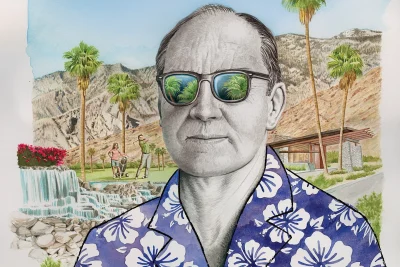
Del Webb imagined a new way to live after 55, a vision that continues to influence new development across the Coachella Valley.
by | May 4, 2026
Courtesy of Palm Springs Life Magazine
North of Avenue 40 in Indio, Del Webb Desert Retreat is well underway on 378 acres, with plans for 1,500 homes and amenities including pickleball courts, a resort-style clubhouse, and a putting green.
For many in the Coachella Valley, Del Webb is a familiar name, tied to some of the desert’s most recognizable active-adult communities, including Sun City Palm Desert, Sun City Shadow Hills in Indio, and Del Webb Rancho Mirage. Del Webb Explore Palm Desert, which opened last winter, dropped the usual 55-and-older restriction to attract Gen X buyers.


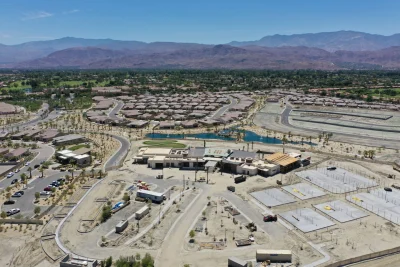
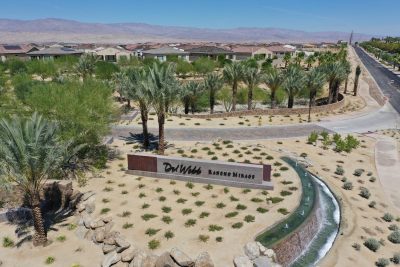
Aerial views of Del Webb Rancho Mirage during and after construction.
But the vision traces back nearly seven decades, when a cotton field in Arizona was transformed into a new kind of community. To understand it, it helps to know the man behind the name.
The story of Del Webb begins with a bounced check. It was a Friday in Phoenix, 1928. A young carpenter named Delbert Webb walked into a bank to cash his weekly pay and was turned away. Turns out his boss had skipped town, leaving behind unpaid debts, as well as a half-finished grocery store.
The building’s owner, desperate, turned to the only man still on the job: Could he finish the job? Webb said he could. And the Del E. Webb Construction Company was born.
The details of this founding story shift a bit depending on who’s telling it, but the essential arc stays the same. Del Webb was a guy left with nothing, and he turned it into something.
Webb had never intended to be a builder.
Tall, with the kind of build that could fill a doorframe, he was first and foremost a baseball player who did some construction work on the side.
Born in Fresno in 1899, Webb grew up pitching semi-pro ball across the West, sometimes under an assumed name to avoid the disapproval of his deeply religious aunts, who considered baseball dangerously close to sin. He was also competitive to the core.
“I can’t remember not being captain of the team,” he said in a Time magazine interview.
A typhoid infection contracted during an exhibition game at San Quentin State Prison changed everything. His weight dropped from more than 200 pounds to 99. Doctors advised dry air and a slower life, so he and his wife, Hazel, relocated to Phoenix. The baseball dreams ended there — but that’s when the building career took off.
By 1935, Webb’s construction company was doing $3 million in annual business. Then, during World War II, it exploded in scale, building air stations, bases, and plants across the country. After President Franklin Roosevelt’s executive order authorized the forced removal of Japanese Americans from the West Coast, Webb’s firm was among the contractors hired to construct detention camps.
That dark chapter is acknowledged today by the Del Webb Sun Cities Museum in Arizona. “You can’t change history, but the best way to address it is to acknowledge it,” says Bill Pearson, a representative of the museum.
Webb’s obsession with order became legend. The company operated by a thick internal manual known as the Blue Book, which governed everything from the lettering on office doors to the color of company cars. (Always black.)
The businessman approached his own life with similar efficiency. He kept meticulous journals for decades, though they read less like diaries and more like a contractor’s logbook. The entry for the day he married his second wife, Toni, is famously spare: a trip to Reno, a two-hour meeting, “then married at 5 p.m.” It goes on to list money spent on meals, car, and tips. ($10.)
“That’s just who he was,” Pearson says. “Not overly emotional but very detail-oriented.”
In the mid-1940s a banker friend asked Webb to help with an unfinished hotel project in Las Vegas. The developer behind it turned out to be Benjamin Siegel — “Bugsy” to the tabloids, though never to his face.
Webb accepted the job and walked carefully through the arrangement. At one point during construction, Siegel mentioned that he had personally killed 12 men and was considering adding another. Noticing Webb’s alarm, Siegel reportedly said, “Del, don’t worry. We only kill each other.”
The project was the Flamingo. Webb went on to build the Sahara, two Las Vegas high schools, City Hall, and facilities at McCarran International Airport, while acquiring other hotels.
Though he had long since played, Webb’s love of baseball endured. In 1945, he and a partner bought the New York Yankees for $2.8 million. Over the next two decades, under his ownership, the Yankees won 15 pennants and 10 World Series, while Webb used the team strategically. Baseball tickets became their own kind of currency, handed out to politicians, business partners, and potential clients. Deals that began in Yankee Stadium luxury boxes often ended with construction contracts elsewhere.
Then came Sun City, the project that continues to define him.
In the late 1950s, Webb was convinced there was a market that most developers weren’t seeing — retired Americans. Housing for older residents existed, but it was usually quiet and modest, built on the assumption that people wanted to remain close to where they came from. Webb suspected something different. What if retirement wasn’t about slowing down at all? What if they could experience swimming pools, clubs, and new friends instead?

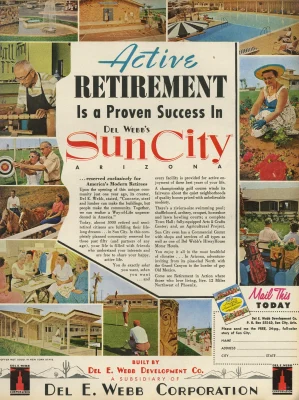
An early advertisement for Sun City Arizona, the predecessor to Webb’s communities in the Coachella Valley.
One of Webb’s executives, Thomas Breen, helped refine the idea. It sounded risky, even a little strange. A whole town for retirees, carved out of a former cotton ranch in Arizona. Early advertisements invited people on “the freedom side of 50” to come west and “try active retirement … for a change!”
On New Year’s Day 1960, Webb opened the model homes and waited to see who might show up. His executives hoped to get maybe 10,000 visitors. More than 100,000 people arrived. Sun City soon became a national phenomenon, copied by developers across the country.
Webb himself never slowed down long enough to live in the kind of place he had created. He worked long hours, traveled constantly, and seemed happiest when a new project was just beginning. He eventually died on July 4, 1974, from complications following surgery for lung cancer. (Webb never smoked. In fact, a large NO SMOKING sign sat permanently on his desk.)
Today the Del Webb name continues under PulteGroup, which builds active-adult communities across the country. Another part of his legacy endures through the Del E. Webb Foundation, created during his lifetime, which has awarded hundreds of millions of dollars in grants supporting education, healthcare, and community organizations.
Webb rarely talked about his legacy, but the towns he helped create offer their own measure of what he accomplished. His work was never meant to be a single building or monument. It was neighborhoods, clubhouses, and entire communities where people arrived ready to begin a new chapter of life.
As Webb said in a 1962 interview, “When I see what we’ve built, it’s the most satisfying thing that’s ever happened to me.”